
Check out our curated list of two-way radio service providers.
What Is Radio Over IP (RoIP)?
How RoIP Connects Two-Way Radios, Dispatch Consoles, and Networks
Radio over IP (RoIP) is a technology that allows two-way radios, dispatch consoles, and remote users to communicate using standard IP networks such as LANs, WANs, VPNs, or the Internet. Instead of relying on dedicated circuits or tone remote systems, RoIP converts radio audio and signaling into IP packets that can travel across modern network infrastructure.
RoIP systems are widely used in transportation, utilities, public safety, education, manufacturing, and other industries that depend on reliable radio communications across multiple locations.
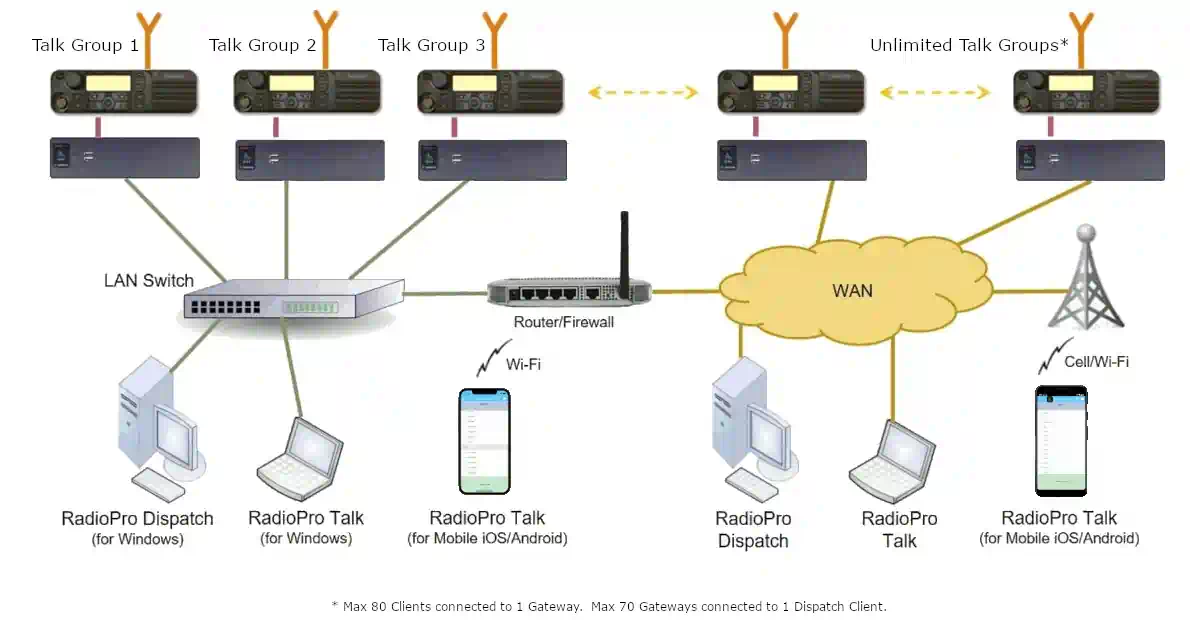
A typical RoIP system includes a control station radio, a RoIP gateway device, and dispatch or mobile client software that allows users to communicate with the radio network across an IP connection.
How Radio Over IP Works
In a traditional radio system, dispatch consoles communicate with radios through dedicated analog circuits or tone remote control links. A RoIP gateway replaces those circuits by converting radio audio and control signals into IP data.
- A control station radio connects to a RoIP gateway.
- The gateway converts audio and signaling into IP packets.
- Those packets travel across an IP network.
- Dispatch consoles or remote users connect through software applications.
This architecture allows radio users to access channels from anywhere with a network connection.
Benefits of Radio Over IP
- Connect radio systems across multiple sites or cities.
- Enable remote dispatch consoles over the Internet.
- Extend radio coverage beyond RF range.
- Integrate radios with software applications and mobile devices.
- Reduce infrastructure costs compared to dedicated circuits.
RoIP systems are especially useful for organizations that operate across multiple facilities or geographic areas.
What Is a RoIP Gateway?
A RoIP gateway is the hardware device that connects a two-way radio to an IP network. The gateway performs several important functions:
- Converts radio audio into compressed IP packets
- Translates radio control signals
- Routes communications between dispatch clients and radios
- Maintains reliable connectivity across the network
Once installed, a RoIP gateway allows dispatch consoles, PC users, and mobile users to communicate with the radio network.
RoIP Systems for Motorola and Kenwood Radios
Many organizations use RoIP technology with professional land-mobile radio systems such as:
- Motorola MOTOTRBO™
- Kenwood NEXEDGE™
- Other digital or analog LMR systems
These systems often use RoIP to support remote dispatch, multi-site networks, and integration with software applications.
Example: RadioPro Radio Over IP System
The RadioPro™ IP Gateway is an example of a RoIP gateway that connects control station radios to IP networks. When combined with software clients such as RadioPro Dispatch, RadioPro Solo, and RadioPro Talk, organizations can create a flexible radio over IP system that allows dispatching and monitoring from anywhere.
Because each RadioPro IP Gateway operates independently, a system can scale from a single site to large multi-site radio networks.
Common Applications for RoIP Systems
- Transportation and fleet operations
- Utilities and energy companies
- Manufacturing facilities
- Education and campus security
- Public safety and emergency response
By using RoIP technology, these organizations can maintain reliable communications even when teams are distributed across large geographic areas.
RoIP vs Traditional Radio Networks
Traditional radio dispatch systems often rely on tone remote circuits, microwave links, or leased lines. Radio Over IP systems replace these connections with IP networking, allowing radio systems to operate across standard Ethernet networks, VPN connections, or the Internet.
Many organizations deploy a RoIP gateway at each radio site so that dispatch operators and remote users can connect to the radio network through software clients or mobile applications.